

PDL delivering effective dewatering solutions in challenging CHALK aquifers.
Reading Phase 2
Overview
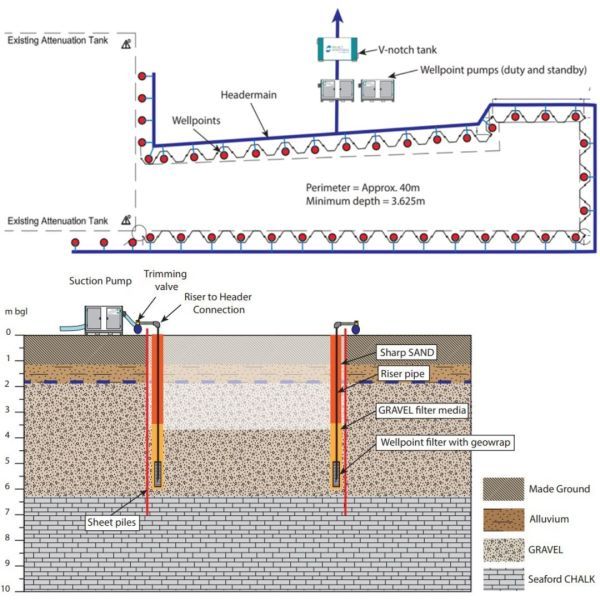
A dewatering system was required to manage potentially high groundwater ingress during the excavation and construction of an attenuation tank. The excavation had an approximate perimeter of 40 m, with a formation level extending to a minimum depth of 3.625 m below ground level.
The ground profile comprised Made Ground over Alluvium over medium dense gravel, underlain by Seaford Chalk encountered at approximately 6.65 m below ground level. Groundwater was recorded at approximately 1.9 m below ground level.
Our Approach
Based on previous experience at the site, PDL had a detailed understanding of the likely permeability values and the hydraulic connectivity between the Chalk and the overlying gravels. This knowledge enabled the design of a robust and efficient dewatering solution tailored to the site conditions.
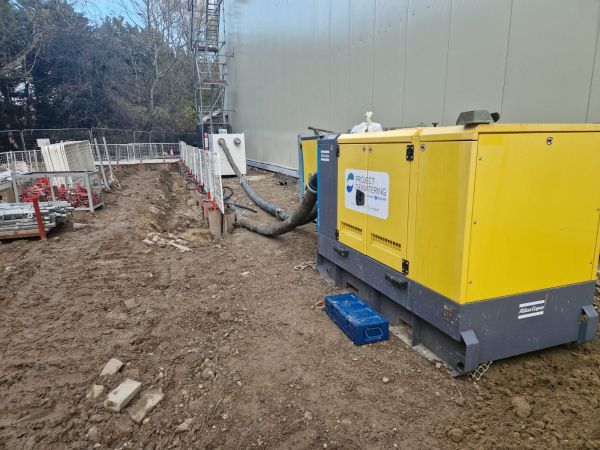
A perimeter wellpoint dewatering system was proposed to deliver the required drawdown, reduce hydrostatic pressures beneath the excavation base, and manage the anticipated high flow rates. The wellpoints were installed internally to the sheet piles at 1 m spacing and to a depth of 6 m. In addition, several external wellpoints were installed to manage groundwater inflow where gaps in the sheet piles were present.
Outcome
The dewatering system successfully enabled the client to reach formation level and was subsequently decommissioned and removed from site. The wellpoint system discharged groundwater at a high rate while maintaining discharged water free of fines, supporting safe and efficient construction activities.
Dover Docks
Overview
Urgent dewatering works were required at Dover after groundworks were halted due to groundwater ingress through the base of an excavation. The proposed sheet piled excavation had an approximate perimeter of 84 m and extended to depths ranging from 9 m to 13.3 m below ground level.
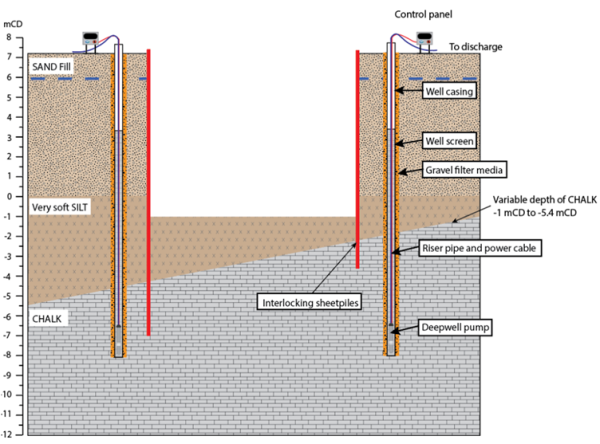
The ground conditions generally comprised sand fill over very soft silt, underlain by Chalk. Groundwater levels were assumed to be approximately 2 m below ground level.
Our Approach
PDL proposed and installed a deep well dewatering system. Due to site constraints, all dewatering wells were required to be located externally to the sheet piles. The system was designed to target areas experiencing excessive groundwater ingress and to reduce the hydraulic pressures responsible for base inflow.
The wells were installed into the Chalk and extended beyond the toe level of the sheet piles, with final depths ranging between 15 m and 17 m. Installation was carried out using roto sonic and rotary drilling techniques. Each well was constructed with suitably graded filter media and slotted well screens to minimise the abstraction of fine particles.
Very hard Chalk was encountered during drilling, and tidal influences further increased the technical difficulty of the works. Despite these challenges, PDL successfully completed the installation of the dewatering wells.
Outcome
The dewatering system effectively controlled groundwater ingress, allowing the client to reach formation level and pour the base slab. Although technically challenging, the project was successfully delivered through a thorough design process and the application of PDL’s experience in complex dewatering conditions.