

recent projects utilising wellpoint dewatering systems across england
OXFORDSHIRE DEWATERING
Overview
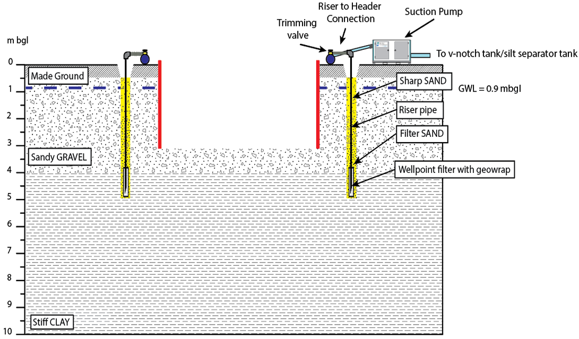
A client requested several dewatering installations to facilitate the excavation of a 30 m pipeline, a flowmeter chamber, and a flow control chamber in Oxfordshire. The pipeline extended down to 2 m below ground level, and the flowmeter and flow control chambers extended 3.3 m and 2.75 m deep respectively with perimeters of 13 m and 11 m. Around the sites, the subsurface strata sequence is recorded as sand over clay, with clay typically encountered at 4 mbgl. Shallow groundwater on site was recorded as 0.9-1.0 mbgl.
Our Approach
To dewater the pipeline, PDL designed a double-sided wellpoint system, with wellpoints installed on both sides along the side of the trench. The wellpoints toed 1 m into the clay to ensure that the system captured as much overbleed as possible. The wellpoint systemextended beyond the limits of excavation to avoid excessive inflow from open ends.
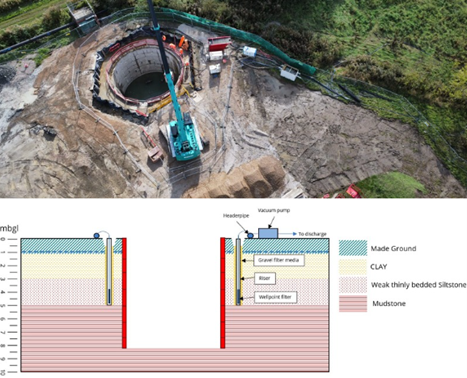
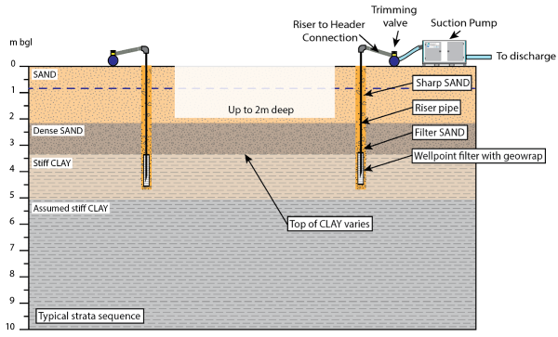
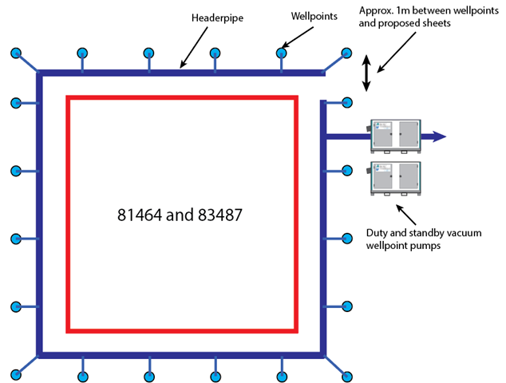
Two perimeter wellpoint systems were installed to achieve dewatering for the flowmeter and flow control chambers. Once the initial installation was completed, the installed wellpoints were then leapfrogged to the next chamber. These wellpoints were also placed 1 m into the underlying clay and spaced at approximately 1 m centres where practicable.
Outcome
All three dewatering systems were able to successfully lower the groundwater level to the required horizons and the excavations were able to go ahead without any difficulty. The utilisation of a silt separator tank ensured that the discharge water was free of fines, adhering to responsible abstraction activities.

MANCHESTER DEWATERING
Overview
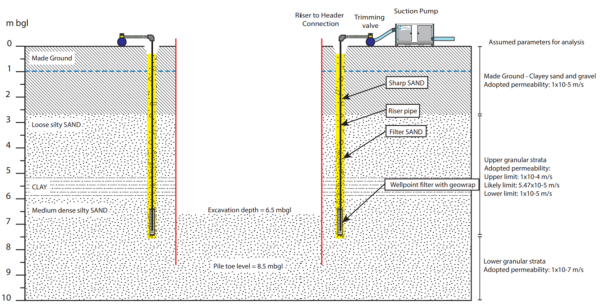
A dewatering system was required to manage high hydrostatic pressures acting on a proposed excavation for the construction of a new Combined Sewer Overflow (CSO) comprising below-ground storage. The proposed sheet piled excavation extended down to approximately 6.5 m below ground level and had a perimeter of 75 m.
The subsurface showed a succession of a relatively thick layer of Made Ground overlying silty sand. A clay horizon was encountered between approximately 5.20-6.20 mbgl, underlain by slightly clayey/silty sand over another clay horizon at 10.65 mbgl. Groundwater was found within the Made Ground at 1 mbgl.
Our Approach
PDL has designed a perimeter wellpoint system to be installed externally to the sheet piles. These are to be installed to a maximum depth of 7.5 mbgl, toeing into the lower permeability granular strata. The wellpoints will aim to lower the groundwater within the upper granular aquifer to below excavation formation level, reducing the hydrostatic pressures acting upon the sides of the excavation.
Where sheet piles will limit groundwater inflow by limiting lateral flow into the excavation, residual groundwater inflow will be managed using a hydraulically
driven submersible pump where required.
PDL has undertaken the necessary checks to ensure that this dewatering system complies with the Environmental Agency’s new regulatory position statement (RPS 368). This allows the client to dewater their site and return abstracted groundwater back into the environment without the need for an abstraction licence.
Outcome
This project is ongoing, however, the works so far have been progressing smoothly and to plan. PDL is continuously keeping in touch with the client, and we are anticipating another successful dewatering outcome.
